The Life of Pi

Yan Martel’s Pi is Piscine Molitor Patel, a boy from Pondicherry, one of the few Indian towns to be colonized by France. Pi is an intelligent, unusual child: he has a scientific turn of mind but is also a practising Hindu, Moslem, and Christian. Pi’s family runs a large zoo, but they decide to sell their animals to zoos in the United States and emigrate to Canada. Crossing the Pacific (with their animals), they’re shipwrecked halfway between China and Midway. Pi survives, only to find himself sharing a lifeboat with an injured zebra, a spotted hyena, an orangutan, and Richard Parker–an immense Bengal tiger. Most of these animals are doomed, but Pi and Richard Parker cling to life, establishing a tacit order on the lifeboat. Martel handles this part of the story perfectly: one would expect Life of Pi to become cute, or perhaps preachy, but it is neither. Life on the boat proceeds in strict accordance with the rules of ecology and territorialism, and the interdependence of the passengers is both believable and absorbing.

Yan Martel was born in Spain and now lives in Montreal.

The book won the Man Booker Prize. Praise from Margaret Atwood The Sunday Times (London): Life of Pi is not just a readable and engaging novel, it’s a finely twisted length of yarn – yarn implying a far fetched story you can’t quite swallow whole, but can’t dismiss outright. Life of Pi is in this tradition – a story of uncertain veracity, made credible by the art of the yarn-spinner. Like its noteworthy ancestors, among which I take to be Robinson Crusoe, Gulliver’s Travels, the Ancient Mariner, Moby Dick and Pincher Martin, it’s a tale of disaster at sea coupled with miraculous survival – a boy’s adventure for grownups.
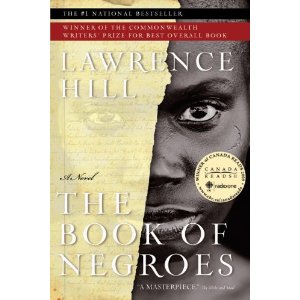
The Book of Negroes

Abducted as an 11-year-old child from her village in West Africa and forced to walk for months to the sea in a coffle – a string of slaves – Aminata Diallo is sent to live as a slave in South Carolina. But years later, she forges her way to freedom, serving the British in the Revolutionary War and registering her name in the historic “Book of Negroes”. This book, an actual document, provides a short but immensely revealing record of freed Loyalist slaves who requested permission to leave the US for resettlement in Nova Scotia, only to find that the haven they sought was steeped in an oppression all of its own. Aminata’s eventual return to Sierra Leone – passing ships carrying thousands of slaves bound for America – is an engrossing account of an obscure but important chapter in history that saw 1,200 former slaves embark on a harrowing back-to-Africa odyssey. Lawrence Hill is a master at transforming the neglected corners of history into brilliant imaginings, as engaging and revealing as only the best historical fiction can be. A sweeping story that transports the reader from a tribal African village to a plantation in the southern United States, from the teeming Halifax docks to the manor houses of London, The Book of Negroes introduces one of the strongest female characters in recent Canadian fiction, one who cuts a swath through a world hostile to her colour and her sex.

Lawrence Hill‘s book won the Commonwealth Writer’s prize for Best Overall Book and became the reader’s pick for Canada Reads 2009. He is a personable writer and visited Westdale to talk to our students last year.

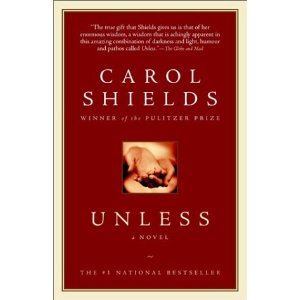
Unless

“A life is full of isolated events,” writes Carol Shields near the end of Unless, “but these events, if they are to form a coherent narrative, require odd pieces of language to link them together, little chips of grammar (mostly adverbs or prepositions) that are hard to define… words like therefore, else, other, also, thereof, therefore, instead, otherwise, despite, already, and not yet.” Shield’s explanation for her novel’s title lends meaning to this multilayered narrative in which a mother’s grief over a daughter’s break with the family revises her feminist outlook and pushes her craft as a writer in a new direction.

The oldest daughter of 44-year-old Reta Winters suddenly, inexplicably, drops out of college and ends up on a Toronto street corner panhandling, with a cardboard sign around her neck that reads “goodness.” The quiet comforts of Reta’s small-town life and the constancy of her feminist perspective sustain her hope that her daughter will snap out of this, whatever “this” is. Threaded into her family’s crisis is her ongoing internal elegy on the exclusion of women from the literary canon, which she transposes to mean her daughter’s exclusion from humanity. Reta wonders if her daughter has discovered, as she herself did years before, that the world is “an endless series of obstacles, an alignment of locked doors,” and has chosen to pursue the one thing that doesn’t require power or a voice: goodness.

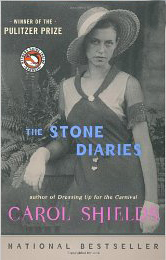
Carol Shields has also written The Stone Diaries

“She enlarges on the available material, extends, shrinks, reshapes what’s offered; this mixed potion is her life. She swirls it one way or the other, depending on – who knows what it depends on? – the fulcrum of desire, or of necessity. She might drop in a ripe plum from a library book she’s reading or something out of a soap opera or a dream.”

The life in question belongs to Daisy Goodwill Flett, “a middle-class woman, a woman of moderate intelligence and medium-sized ego and average good luck.” In other words, a woman so commonplace that her story would seem barely worth remarking, were it not, perhaps, for her own determination to tell it. And in telling it, give it shape and meaning – even if she must supply these herself.

This is the problem that Carol Shields addresses in The Stone Diaries: how do small lives, the kind most women were once assumed to lead, assume significance and coherence? How closely do our versions of those lives correspond to objective facts? Can facts be said to exist at all in the context of something as changeable and arbitrary as a life? To what extent do “our” stories really belong to us, considering the tendency that other people – parents, spouses, children – have to intrude in them, interpret them, claim them? (URL reference)

Sylvanus Now

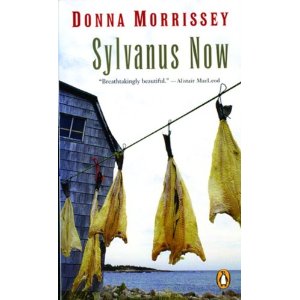
A love story set amid the terrible beauty of Newfoundland’s coast by Donna Morrissey. Sylvanus Now is a young fisherman of great charm and strength. His youthful desires are simple: He wants a suit to lure a girl—the fine-boned beauty Adelaide. Adelaide, however, has other dreams. Set against the love story of Addie and Sylvanus is the sea on the cusp of cataclysmic change. Caught between his desire to please his wife and his strongly independent nature, Sylvanus must decide what path his future will take.

The Underpainter

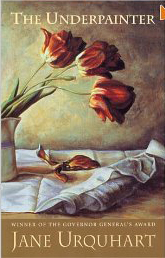
Winner of the Governor General’s Award, this is Jane Urquhart‘s first novel. Urquhart pinpoints the book’s origins to the east coast. “Everyone says, I’m sure, that their novel began with a visual image,” she laughs. “Well, my novel began with a visual image. I was in Newfoundland, standing on a beach in Brigus Bay, and I looked across to an arm of land that was sticking out into the ocean, and there was the most wonderful house I have ever seen. Very old, very weatherbeaten, up on a cliff looking down on the ocean. I said to Joan Clark, the writer, who was with me, ‘I want that house, it has to be mine.’ I’m very covetous about architecture. And she said, ‘Well, that’s where Rockwell Kent lived when he was in Newfoundland.’”

Urquhart, who studied art history in university, knew something of Kent, a New York-born painter dating to the early part of this century who was associated with Robert Henri’s Ashcan School. She had no idea that he’d settled in Newfoundland, let alone that he’d been unceremoniously expelled during the First World War – for singing German lieder from the porch of his rented house. (taken from an interview with Quill & Quire)