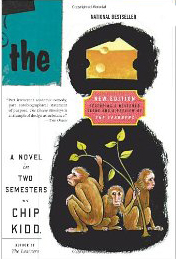
 A sharp, fast-paced, and well-packaged academic satire, this is a coming-of-age story from the point of view of the paying victim (a.k.a. the student). A naive fellow finds himself in the hallowed, cinderblock halls of his state art school in the 1950s where, try as he might, he can’t quite capture in pencil the essence of a decapitated waterfowl, an old shoe, and a detumescent pomegranate. No wonder he becomes enthralled by the charms of one Himillsy Dodd, a free spirit and the only other enrollee in the still-life course who seems to know the meaning of “detumescent.” The following semester, the duo find themselves in Art 127: Introduction to Commercial Art, and the novel shifts typeface and turns into a syllabus for what might be the ultimate graphic design class. Winter Sorbeck challenges his students and himself perhaps beyond what today’s law allows, but the results are all recorded in indelible ink on their Permanent Academic Records, though the novel’s painful conclusion does find Sorbeck out job hunting. Chip Kidd is an award-winning graphic artist responsible for the memorable book jackets for such titles as Jurassic Park and Love in the Time of Cholera. He is an interesting fellow and a very good speaker.
On his new book, The Learners.
Category: ENG4U Reading List
The Book of Negroes
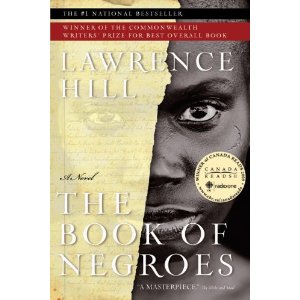 Abducted as an 11-year-old child from her village in West Africa and forced to walk for months to the sea in a coffle – a string of slaves – Aminata Diallo is sent to live as a slave in South Carolina. But years later, she forges her way to freedom, serving the British in the Revolutionary War and registering her name in the historic “Book of Negroes”. This book, an actual document, provides a short but immensely revealing record of freed Loyalist slaves who requested permission to leave the US for resettlement in Nova Scotia, only to find that the haven they sought was steeped in an oppression all of its own. Aminata’s eventual return to Sierra Leone – passing ships carrying thousands of slaves bound for America – is an engrossing account of an obscure but important chapter in history that saw 1,200 former slaves embark on a harrowing back-to-Africa odyssey. Lawrence Hill is a master at transforming the neglected corners of history into brilliant imaginings, as engaging and revealing as only the best historical fiction can be. A sweeping story that transports the reader from a tribal African village to a plantation in the southern United States, from the teeming Halifax docks to the manor houses of London, The Book of Negroes introduces one of the strongest female characters in recent Canadian fiction, one who cuts a swath through a world hostile to her colour and her sex.
Lawrence Hill‘s book won the Commonwealth Writer’s prize for Best Overall Book and became the reader’s pick for Canada Reads 2009. He is a personable writer and visited Westdale to talk to our students last year.
Unless
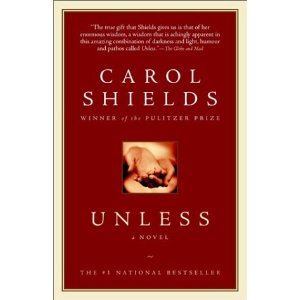 “A life is full of isolated events,” writes Carol Shields near the end of Unless, “but these events, if they are to form a coherent narrative, require odd pieces of language to link them together, little chips of grammar (mostly adverbs or prepositions) that are hard to define… words like therefore, else, other, also, thereof, therefore, instead, otherwise, despite, already, and not yet.” Shield’s explanation for her novel’s title lends meaning to this multilayered narrative in which a mother’s grief over a daughter’s break with the family revises her feminist outlook and pushes her craft as a writer in a new direction.
The oldest daughter of 44-year-old Reta Winters suddenly, inexplicably, drops out of college and ends up on a Toronto street corner panhandling, with a cardboard sign around her neck that reads “goodness.” The quiet comforts of Reta’s small-town life and the constancy of her feminist perspective sustain her hope that her daughter will snap out of this, whatever “this” is. Threaded into her family’s crisis is her ongoing internal elegy on the exclusion of women from the literary canon, which she transposes to mean her daughter’s exclusion from humanity. Reta wonders if her daughter has discovered, as she herself did years before, that the world is “an endless series of obstacles, an alignment of locked doors,” and has chosen to pursue the one thing that doesn’t require power or a voice: goodness.
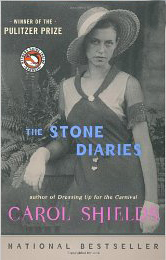
Carol Shields has also written The Stone Diaries
“She enlarges on the available material, extends, shrinks, reshapes what’s offered; this mixed potion is her life. She swirls it one way or the other, depending on – who knows what it depends on? – the fulcrum of desire, or of necessity. She might drop in a ripe plum from a library book she’s reading or something out of a soap opera or a dream.”
The life in question belongs to Daisy Goodwill Flett, “a middle-class woman, a woman of moderate intelligence and medium-sized ego and average good luck.” In other words, a woman so commonplace that her story would seem barely worth remarking, were it not, perhaps, for her own determination to tell it. And in telling it, give it shape and meaning – even if she must supply these herself.
This is the problem that Carol Shields addresses in The Stone Diaries: how do small lives, the kind most women were once assumed to lead, assume significance and coherence? How closely do our versions of those lives correspond to objective facts? Can facts be said to exist at all in the context of something as changeable and arbitrary as a life? To what extent do “our” stories really belong to us, considering the tendency that other people – parents, spouses, children – have to intrude in them, interpret them, claim them? (URL reference)
Empire Falls
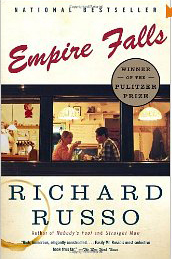 Winner of the Pulitzer Prize. From Dust Jacket: Miles Roby has been slinging burgers at the Empire Grill for 20 years, a job that cost him his college education and much of his self-respect. What keeps him there? It could be his bright, sensitive daughter Tick, who needs all his help surviving the local high school. Or maybe it’s Janine, Miles’ soon-to-be ex-wife, who’s taken up with a noxiously vain health-club proprietor. Or perhaps it’s the imperious Francine Whiting, who owns everything in town–and seems to believe that “everything” includes Miles himself. In Empire Falls Richard Russo delves deep into the blue-collar heart of America in a work that overflows with hilarity, heartache, and grace.
Sylvanus Now
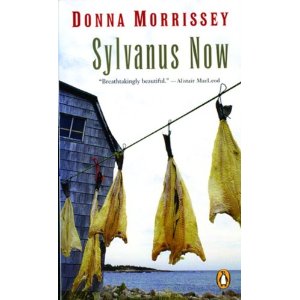 A love story set amid the terrible beauty of Newfoundland’s coast by Donna Morrissey. Sylvanus Now is a young fisherman of great charm and strength. His youthful desires are simple: He wants a suit to lure a girl—the fine-boned beauty Adelaide. Adelaide, however, has other dreams. Set against the love story of Addie and Sylvanus is the sea on the cusp of cataclysmic change. Caught between his desire to please his wife and his strongly independent nature, Sylvanus must decide what path his future will take.
 Digitizeme