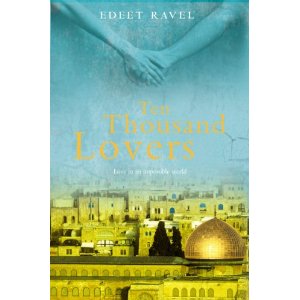
Ten Thousand Lovers

Edeet Ravel was born on an Israeli kibbutz and now lives in Canada. Lily is a young emigrant student exploring the wonders and terrors of her new land when she meets the man of her dreams. Ami, a former actor, is handsome, intelligent and exciting – but, like his beautiful, disintegrating country, he has a terrible flaw – he is an army interrogator.

Exerpt: “Fashila is an Arabic word meaning to fail, lose courage, despair, be disappointed, act in a cowardly way. In Hebrew slang, fashla means mess-up, snafu, an embarrassing or disastrous or humiliating mistake. You can use it for small things, like forgetting you had to meet someone, or you can use it for big things like the Yom Kippur War. A box-cell is a cell that is five feet by five feet by two and a half feet. The person can’t stand up or stretch out. You find box-cells in most Israeli prisons: they’re punishment cells, and nobody lasts very long in them – people start going mad fast and they don’t want to go back in once they’ve been let out.”
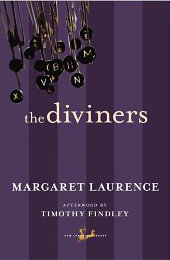
The Diviners

Margaret Laurence (1926-1987), writer, was born Jean Margaret Wemyss in the prairie town of Neepawa, Manitoba, which inspired her fictional “Manawaka”. Her parents, of Scottish and Irish descent, died when she was young and she was brought up by an aunt who had become her stepmother. From 1944 to 1947, Margaret Wemyss attended United College, Winnipeg, with a scholarship and graduated with a B.A. honours in English. She worked as a reporter for the Winnipeg Citizen upon graduation and married Jack Laurence, a civil-engineering graduate of the University of Manitoba, the same year. In 1949, they moved to England and one year later, they left for Africa and remained there for seven years, first in the British Protectorate of Somaliland (now Somalia) (1950-2), then in Ghana just before its independence (1953-7). (from York University archives)

The Diviners is a novel about Morag Gunn, a novel that I read for the first time in my first year at Carleton University. It was intense and intriguing, a young girl growing up without her parents, trusted to an eccentric aunt and uncle, in abject poverty. She navigates her way into adulthood and retells the story of her life from an adulthood that included a daughter very much like herself. You won’t be disappointed in this story. This novel won her the Governor General’s award for Fiction in 1974. She wrote a couple of other  books set in Manawaka: A Jest of God, The Fire-Dwellers and Stone Angel.

McMaster University professor James King wrote a biography on the life of Margaret Laurence that is intimate and revealing, a must for devoted Laurence fans.

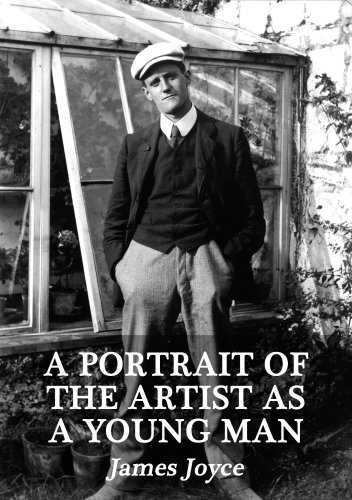
A Portrait of the Artist as a Young Man

Works by James Joyce:

Collected Poems, Dubliners, Exiles (play), Finnegans Wake, Ulysses, Giacomo Joyce.

Excerpt from Portrait of the Artist: Once upon a time and a very good time it was there was a moocow coming down along the road and this moocow that was coming down along the road met a nicens little boy named baby tuckoo… His father told that story: his father looked at him through a glass: he had a hairy face. He was baby tuckoo. The moocow came down the road where Betty Bryne lived: she sold lemon platt.

Like some of the best novels in the world it is the story of an education: it is by far the most living and convincing picture that exists of an Irish Catholic upbringing. It is a mosaic of jagged fragments that does altogether render with extreme completeness the growth of a rather secretive, imaginative boy in Dublin…One believes in Stephen Dedalus as one believes in few characters in fiction. H. G. Wells 1916

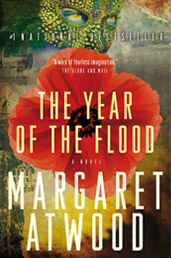
The Year of the Flood

Margaret Atwood, the darling of  Canadian literature has written an apocalyptic, futuristic novel, The Year of the Flood (reading_sample)

Adam One, the kindly leader of the God’s Gardeners – a religion devoted 2 the melding of science, religion, and nature – has long predicted a disaster. Now it has occurred, obliterating most human life. Two women remain: Ren, a young dancer locked away in a high-end sex club, and Toby, a former God’s Gardener, who barricades herself inside a luxurious spa. Have others survived? Ren’s bio-artist friend Amanda? Zeb, her eco-fighter stepfather? Her onetime lover, Jimmy? Or the murderous Painballers? Not to mention the CorpSeCorps, the shadowy policing force of the ruling powers… As Adam One and his beleaguered followers regroup, Ren and Toby emerge into an altered world, where nothing – including the animal life – is predictable. (taken from web site)

Atwood is an essential read for anyone who is Canadian or would like to understand the Canadian psychi.  Other books:

The Edible Woman (1969) for all you feminists; Surfacing (1972); Lady Oracle (1976); Life Before Man (1979); Bodily Harm (1981); The Handmaid’s Tale (1985); Cat’s Eye (1988); The Robber Bride (1993); Alias Grace (1996); The Blind Assassin (2000); Oryx and Crake (2003); The Penelopiad (2005); The Year of the Flood (2009). I have read all of these, the only one hard to finish was The Blind Assassin, the rest I would recommend!

Atwood has also written several short fiction collections. The one I would recommend would be The Tent (2006), a strange tale of a couple haunted by the images seen through the film of their tent in flickered images of light. I have also read Moral Disorder (2006); Wilderness Tips (1991) and Dancing Girls (1977). Atwood has also written these collections: Murder in the Dark (1983); Bluebeard’s Egg (1983); Good Bones (1992); Good Bones and Simple Murders (1994); The Labrador Fiasco (1996)

Selected passages from the book, Negotiating with the Dead: A Writer on Writing. Essential read for aspiring writers.

Follow Ms Atwood on Twitter

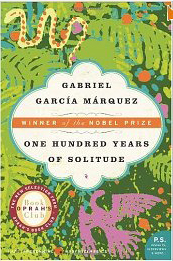
One Hundred Years of Solitude

Gabriel Garcia Marquez is a Colombian born author who won the Nobel Prize for Literature for this first novel. It is described as the most influential literary work of our time, the greatest revelation in the Spanish language since Don Quixote of Cervantes (Chilean poet and Novel laureate Pablo Neruda).

It is a story that spans many generations and gives the reader a glimpse of history, culture, life with all the mythology, miracles  – stories first told by his grandmother. Marquez’s own story is a rags to riches saga, as this first book catapults him to international recognition.

From the book jacket: One Hundred Years of Solitude tells the story of the rise and fall, birth and death of the mythical town of Macondo through the history of the Buendia family. Inventive, amusing, magnetic, sad and alive with unforgettable men and women.

An except from the novel:

“Poor great-great-grandmother,” Amaranta Ursula said. “She died of old age.”

Ursula was startled.

“I am alive!” she said.

“You can see,” Amaranta Ursula said, suppressing her laughter, “that she’s not even breathing.”

“I’m talking!” Ursula shouted.

“She can’t even talk,” Aureliano said. “She died like a little cricket.”

Then Ursula gave in the the evidence. “My God,” she exclaimed in a low voice. “So this is what it’s like to be dead.”

Another shorter book by the same author that was very interesting, Chronicles of a Death Foretold. A gentleman is ambushed by two local men, brothers of a recently married, then disgraced girl (apparently by the poor murdered chap), who is brutally stabbed in broad daylight. The book reads like a murder mystery where everyone in town seemed to know about what was going to happen except the murder victim. Humourous with a distinct Caribbean flavour, this is a good read.