
Category: General Discussion
Miscellaneous and sundry items for discussion.
iPads in the Classroom
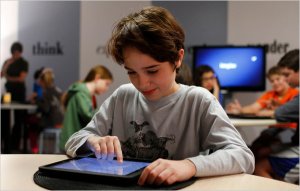
Math That Moves: Schools Embrace the iPad
Hundreds of schools in the New York area are purchasing iPads to replace textbooks, eliminate paper (and photo copying), and engage students. The article doesn’t refer to the research that has already been done on how using technology can improve student achievement.
“The Impact of Educational Technology on Student Achievement, What the Most Current Research Has to Say” by John Schacter summarizes the positive and negative impact of technology on student achievement by looking at over 500 individual research studies. He found that, on average, students who used computer based instruction scored at the 64th percentile on tests of achievement compared to students in the control conditions without computers who scored at the 50th percentile and that students learn more in less time when they receive computer based instruction, plus students like their classes more and develop more positive attitudes when their classes include computer based instruction.
The Ontario Ministry of Education’s “Growing Success” document outlines how to use assessment for learning. When students keep blogs for reflection about personal development, they can track their own learning. If students are to “set individual goals, monitor their own progress, determine next steps and reflect on their thinking and learning”, what better tool to facilitate this process than an iPad. The device is readily available, welcoming and as personable as Facebook, easy to post reflections on and just as easy to refer back to. It even comes with a calendar to help monitor and track progress. (Assessment For Learning and As Learning, page 28)
Effective use of technology in learning fosters collaboration, networking partnerships. Flat Classroom Project is an example of effective global collaboration. Students from around the world collaborate together to produce a wiki about technology and documentaries about the technology trends. The project is based on Thomas Friedman’s book, “The World is Flat”, a commentary on how technology has facilitated the global economy. The project was the brain child of Vicki Cook and Julie Lindsay and it has become a mecca for thousands of students who embrace diversity and engage with technology to collaborate.
ISTE has some ideas on how to use the iPad in education. Check out the page HERE.
ISTE also talks about some of the 1,000 apps designed for the iPad HERE.
So, overall, it looks to me like the iPads have it – bring them on!
Wendy
Let's have a book burning!
Betty Ray talks about the traditional textbook:
Medium does matter. And the textbook is generally a medium that inspires neither motivation nor imagination. If textbooks were inspiring and everyone wanted to read them, they’d be at the top of the New York Times’ bestseller list. But they’re not.
As a teacher, I’d say that the best things textbooks do are a) make my life easier by supplying me with reading passages, questions, and projects for the kids to do, b) organize the class material in such a way that we can stay on a steady course, and c) make it easy for colleagues and I teaching the same classes to “keep on the same page,” so to speak. And in all three cases, the textbook serves the teacher quite well.
Unfortunately, the textbook does not serve the students quite as well.
Read further in her Blog Post in Edutopia
Introduction | A 21st Century Education Film Series
This is a documentary film series that demonstrates how educators have used technology and project based learning to move education into the 21st Century.
Sir Ken Robinson: Bring on the learning revolution!
Quotes from the talk:
And we have sold ourselves into a fast food model of education. And it’s impoverishing our spirit and our energies as much as fast food is depleting our physical bodies.
And the reason so many people are opting out of education is because it doesn’t feed their spirit, it doesn’t feed their energy or their passion.
So I think we have to change metaphors. We have to go from what is essentially an industrial model of education, a manufacturing model, which is based on linearity and conformity and batching people. We have to move to a model that is based more on principles of agriculture. We have to recognize that human flourishing is not a mechanical process, it’s an organic process. And you cannot predict the outcome of human development; all you can do, like a farmer, is create the conditions under which they will begin to flourish.
WB Yeats says this: “Had I the heavens embroidered cloths, Enwrought with gold and silver light, The blue and the dim and the dark cloths of night and light and the half-light, I would spread the cloths under your feet; But I, being poor, have only my dreams; I have spread my dreams under your feet; Tread softly because you tread on my dreams.” And every day, everywhere, our children spread their dreams beneath our feet. And we should tread softly.
 Digitizeme