
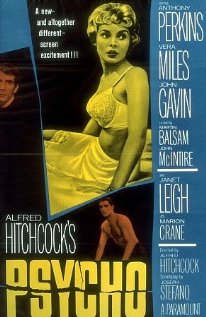
 Alfred Hitchcock’s Psycho
Trivia:
The shower scene took 7 days to shoot with 70 different camera set ups, the scene was only 45 seconds long, a nude model stood in for Janet Leigh; the knife never touched her body; no one was admitted to the theatre after the film was started, Pinkerton guards enforced this rule; people fainted, walked out, wrote death threats to Janet Leigh, sent angry phone calls, preachers talked of banning the film; first time ever included in a movie – a flushing toilet; trade mark cameo appearances in all films.
The story is based on a book by Robert Bloch, inspired by Ed Gein who not only murdered two women and kept their heads in sacks in his house, but robbed over 40 graves and used the body parts to make furniture, nicknacks and a “female skin suit”.
The brilliance was that you were allowed to use your imagination, which is more powerful than explicit gore.
There is a film coming out early 2013 about the making of Psycho, with Anthony Hopkins playing Hitchcock. Read the details HERE
Alfred Hitchcock and the Making of Psycho is the title of a non-fiction book by Stephen Rebello. Rebello interviewed every cast member for this extensive look at Hitchcock’s film and had access to archives and Hitchcock’s personal records.
Hitchcock’s Techniques
Hitchcock felt that the most important part of a film was the audience. He utilized techniques to engage, manipulate and surprise his audience.
1. Juxtapositioning shots to build suspense: the shot will be of the character, his expression, then what he is looking at
2. Controlling the Story
- Hitchcock has the audience identify with the protagonist, but their point of view is not a clear, objective perspective, but skewed and not entirely trustworthy. This creates constant tension between what we see and what is actually occurring. The audience is kept in perpetual suspense.
- With Dialogue – during a conversation the Hitchcock will often show one of the characters preoccupied with something. Their eyes are distracted while the other person doesn’t notice, but his tells the audience something isn’t quite right. The audience is also drawn into a character’s secretive world. The focus of the scene then is not on what they are actually saying, but the sub-text – what they are not saying and the emotions attached to that.
- Only tell the audience what they have to know – careful revealing of information to audience to build and maintain suspense. Keep the audience always thinking, hide from then some critical information so they think of the whys and hows.
- Controlling the pace of the movie: how fast information is revealed, what is happening on screen, the number of plot twists, the number of character introduced and how their stories intertwine.
- Hitchcock used plot devices to create suspense: for example there would be a certain prop tied to the one “deed” that moves the action. In Psycho it is the envelope full of money. The shots include this envelope to remind the audience of the predicament that Marion Crane has gotten herself into and what is at stake.
3. Use Montage to create thrilling scenes: in the shower scene, the cuts are fast, calculated, from various angles
4. Emotional Impact – creating the atmosphere: Use surprise and twists to manipulate audience’s emotions: Psycho, audience becomes attached to Marion Crane, then she is murdered; Norman Bates’s mother turns out to be Norman himself, with her body slowly rotting in her wheel chair.
- use of sound: Hitchcock was the first to use the violin “screeching” in the famous shower scene. This sound has been used many times since and is an iconic sound in all slasher films.
Alfred Hitchcock, ” I don’t care about the subject matter, I don’t care about the acting, but I do care about the pieces of the film and the photography and the soundtrack and all of the technical ingredients that made the audience scream. I feel it’s tremendously satisfying for us to be able to use the cinematic art to achieve something of a mass emotion. And with Psycho we most definitely achieved this. It wasn’t a message that stirred the audiences, nor was it a great performance or their enjoyment of the novel. They were aroused by pure film.”


 Digitizeme