After Effects

Adobe After Effects is the software program for creating special effects. It was used just recently to produce the Oscar winning visual effects for Hugo. Video Copilot is the place to go for tutorials for After Effects. It has both beginner and advanced tutorials.

The basic training tutorials are in this link.

Here are the individual links to the ten basic training tutorials:

1. Introduction All the basics on how to navigate the program

2. Effects How to add simple special effects using the effects and presents pallette to find specific plugins.

3. Animation Animating and adding keyframes. Adding motion blur to animated layers and short cuts.

4. Keying and Transparency How transparency works in After Effects from simple colour keying to transfer modes.

5. Motion Tracking This tutorial covers several kinds of motion tracking including stabilizing a shaky shot, performing a sign replacement and motion tracking video to incorporate motion graphics seamlessly. This is an advanced tutorial.

6. Time Remapping How to create slow motion and how to speed up frames.

7. 3D Integrating Basics of 3D with depth of field covered and particle system. Advanced tutorial.

8a. Titles Part 1      8b. Titles Part 2  Fun with text.

9. Expressions: Scripting Language in After Effects. More advanced tutorial.

10. Rendering: Exporting the finished movie How to export out your files to various formats and compression rates.

Joining the NetGen Project: NING

Go to the Flat Classroom NING
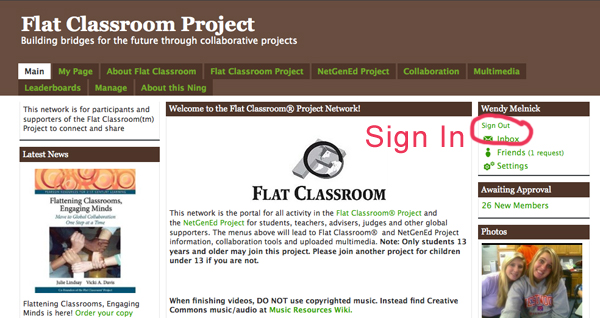
1. Sign up by clicking the SIGN UP words on the right hand side of the wiki. Create an account, using the following formula for the NAME area of the sign up window: JohnD_WSS (first name, last Capitalized initial, underscore, WSS). You must add this in the name area, as there is no option to create a login.

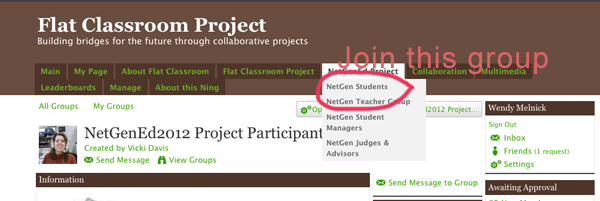
  2. Join the NetGenEd Student Group in the dropdown menu NetGenEd Project.

3. Update your profile page with your school information, an appropriate avatar image,  any interests that you would like to share with the group, etc. You will also create a welcome message either written or a short video.Do not upload any images that are not relevant to the project.

4. Friend all those in our class and those students on your Project Team – and me.

Analyzing the Horizon Report

Themes to be Discussed and Analyzed:

Time-to-Adoption Horizon: One Year or Less
1.Mobile Apps  PDF page 14 – 17 (as read by Adobe Reader or Acrobat)
2. Tablet Computing PDF page 18- 21
Time-to-Adoption Horizon: Two to Three Years
1.Game-Based Learning PDF page 22 – 25
2.Learning Analytics PDF page 26 – 29
Time-to-Adoption Horizon: Four to Five Years
1.Gesture-Based Computing PDF page 30 – 33
2.Internet of Things PDF page 34 – 37

Your Challenge

The Facts:

1. Define your technology.  2. What is it, how does it work, examples. 3. Summarize the overview. 4. What is the relevance for Teaching, Learning or Creative Inquiry. 5. Concrete examples of how this is used in practice, visit the various web sites, summarize what they are doing. 6. Report on at least one other finding in the “Further Readings” section.

Assess and Analyze:

7. Now Assess the technology: Engage the audience in 3 or 4 Socratic questions based on your findings. Consider how your generation will be using this technology when crafting your questions. Does this technology provide more freedom of choice? Does this technology allow for customization of its interface or use? Is information about this technology, its use and development accessible? How does it allow for collaboration?  Does it encourage or impede integrity? Is it fun? Is it fast? Are the companies behind this technology transparent, innovative?

Socratic Questioning:

1. Clarification: why do you say that? Could you explain further?
2. Assumptions: challenging the assumptions. Is this always the case?
3. Evidence as the basis of an argument: Is there reason to doubt this evidence?
4. Alternative viewpoints and perspectives: What is the counter argument? What is another point of view?
5. Implications and Consequences: what if this happened? What are the results of these actions?
6. Question the question: why is this question important? Which are the useful questions?

Timeline on ASM3M Calendar