
If this doesn’t engage those students who are disenchanted with the status quo – will anything?? It has everything a reluctant reader could wish for – interactivity, amazing graphics, the all important cool factor and even words! Learning is supposed to be a discovery, an exciting journey. It won’t be long before the students will be creating books like that on their own.
Category: Multimedia
Ideas connected with multimedia – videos, images, web sites, online collaboration.
Screencast: A Private way to share videos and files
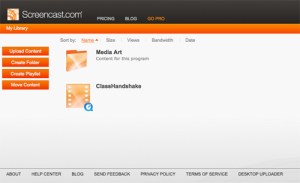
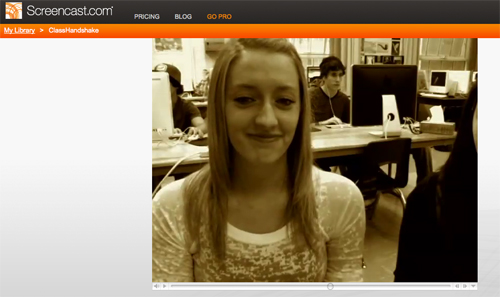
Screencast is a portal where you can post videos, tutorials and slide shows for students, parents or peers. It has a much more professional polished look than Youtube. This is what it looks like with a video playing:
You can organize your content in folders and determine who will see the content with sharing permissions. You can embed the content into another web site or email the link. You can send specific invitations to people and give them permission to see the content. Or you can keep the content public and share the link with your class. Each folder can have various permissions attached to it. This is a free service with upgrades available for a price.
iPads in the Classroom
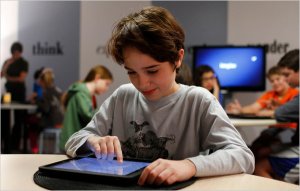
Math That Moves: Schools Embrace the iPad
Hundreds of schools in the New York area are purchasing iPads to replace textbooks, eliminate paper (and photo copying), and engage students. The article doesn’t refer to the research that has already been done on how using technology can improve student achievement.
“The Impact of Educational Technology on Student Achievement, What the Most Current Research Has to Say” by John Schacter summarizes the positive and negative impact of technology on student achievement by looking at over 500 individual research studies. He found that, on average, students who used computer based instruction scored at the 64th percentile on tests of achievement compared to students in the control conditions without computers who scored at the 50th percentile and that students learn more in less time when they receive computer based instruction, plus students like their classes more and develop more positive attitudes when their classes include computer based instruction.
The Ontario Ministry of Education’s “Growing Success” document outlines how to use assessment for learning. When students keep blogs for reflection about personal development, they can track their own learning. If students are to “set individual goals, monitor their own progress, determine next steps and reflect on their thinking and learning”, what better tool to facilitate this process than an iPad. The device is readily available, welcoming and as personable as Facebook, easy to post reflections on and just as easy to refer back to. It even comes with a calendar to help monitor and track progress. (Assessment For Learning and As Learning, page 28)
Effective use of technology in learning fosters collaboration, networking partnerships. Flat Classroom Project is an example of effective global collaboration. Students from around the world collaborate together to produce a wiki about technology and documentaries about the technology trends. The project is based on Thomas Friedman’s book, “The World is Flat”, a commentary on how technology has facilitated the global economy. The project was the brain child of Vicki Cook and Julie Lindsay and it has become a mecca for thousands of students who embrace diversity and engage with technology to collaborate.
ISTE has some ideas on how to use the iPad in education. Check out the page HERE.
ISTE also talks about some of the 1,000 apps designed for the iPad HERE.
So, overall, it looks to me like the iPads have it – bring them on!
Wendy
Project based Learning
A Remarkable Transformation: Union City Public Schools | Edutopia
A Remarkable Transformation: Union City Public Schools | Edutopia.
In one seven-year period, passing eighth-grade test scores jumped from 33 to 83 percent in reading, from 42 to 65 percent in writing, and from 50 to 84 percent in mathematics. College-going rates have increased, and the number of Union City graduates accepted at top institutions like Yale and the Massachusetts Institute of Technology jumped from eight in 1997 to 73 in 2001. Read about the transformation.
 Digitizeme