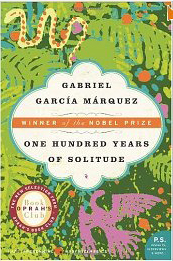
One Hundred Years of Solitude

Gabriel Garcia Marquez is a Colombian born author who won the Nobel Prize for Literature for this first novel. It is described as the most influential literary work of our time, the greatest revelation in the Spanish language since Don Quixote of Cervantes (Chilean poet and Novel laureate Pablo Neruda).

It is a story that spans many generations and gives the reader a glimpse of history, culture, life with all the mythology, miracles  – stories first told by his grandmother. Marquez’s own story is a rags to riches saga, as this first book catapults him to international recognition.

From the book jacket: One Hundred Years of Solitude tells the story of the rise and fall, birth and death of the mythical town of Macondo through the history of the Buendia family. Inventive, amusing, magnetic, sad and alive with unforgettable men and women.

An except from the novel:

“Poor great-great-grandmother,” Amaranta Ursula said. “She died of old age.”

Ursula was startled.

“I am alive!” she said.

“You can see,” Amaranta Ursula said, suppressing her laughter, “that she’s not even breathing.”

“I’m talking!” Ursula shouted.

“She can’t even talk,” Aureliano said. “She died like a little cricket.”

Then Ursula gave in the the evidence. “My God,” she exclaimed in a low voice. “So this is what it’s like to be dead.”

Another shorter book by the same author that was very interesting, Chronicles of a Death Foretold. A gentleman is ambushed by two local men, brothers of a recently married, then disgraced girl (apparently by the poor murdered chap), who is brutally stabbed in broad daylight. The book reads like a murder mystery where everyone in town seemed to know about what was going to happen except the murder victim. Humourous with a distinct Caribbean flavour, this is a good read.
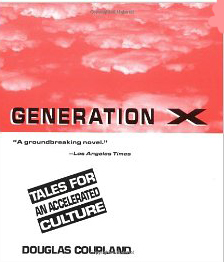
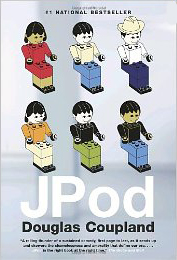
Generation X

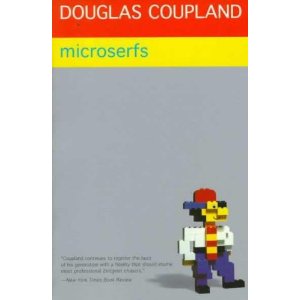
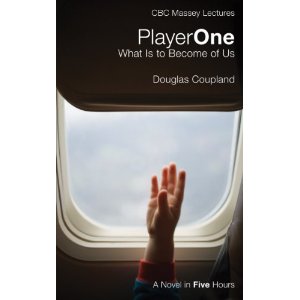
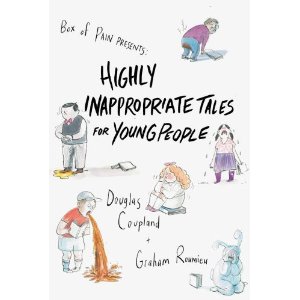
Douglas Coupland is a prolific Canadian writer with thirteen novels, seven non-fiction books, short stories and several screen plays.  He takes a clear view of our digital age children and reveals their angst and joys.

Generation X was his first novel, a hilarious satire on our consumer culture. Chapter names: The Sun is Your Enemy, Dead at 30 Buried at 70, Don’t Eat Yourself. Side notes include: Ozmosis: The inability of one’s job to live up to one’s self-image, Optional Paralysis: The tendency, when given unlimited choices, to make none, Black Holes: An X generation subgroup best known for their possession of almost entirely black wardrobes.

You can read his blog on NYT from 2006.

Bloodletting & Miraculous Cures

Vincent Lam is an emergency doctor in Toronto who has drawn on his own personal experiences to create this “Grey’s Anatomy” style story set in the chaotic arena of Canadian medicine. The characters are realistic, their dilemmas make you laugh/gasp/recoil/ponder. This book won the Giller Prize in 2006.

An excerpt from Take All of Murphy chapter:

“What?” “I’m going to get it,” he shouted. No one turned to look, in the way that drunk people do not notice each other as being out of the ordinary.

“You’re all screwed up,” said Ming quietly. “Do you dream about your Murphy?”

“Me? You should have nightmares, the way you treat him.”

“Hello? Dead? Remember? I don’t have dreams, because I don;’t have hang-ups about stupid corpse.”

“You -”

“You what?” said Ming. “You don’t like that? Corpse? Piece of Murphy meat?”

“You’re such a –”

“Just say it. What am I? You want to say it. Call me a name, go ahead and relieve your repressed little self. Say it.”

“No. Let’s just stop. No.”

“Go for it, pick a name. Bitch? Witch? Name your name.”

“I didn’t say anything, you’re picking the words now.”

“You’re such a wimp, I have to call myself names just to clarify what you think of me,” said Ming.

Chen was pushing sideways through the falling dancers. He arrived in time to hear Ming say to Sri, “Just fuck off. See, I can say what I think.” She stalked off, weaving across the floor.

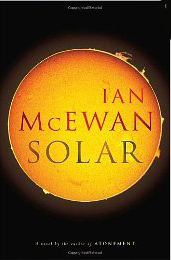
Solar by Ian McEwan

“What he was about to do could not be undone. He would be putting his innocence behind him. He dipped the head of the hammer in the puddle of blood, smeared the handle, and set is aside to dry. Next he took the used paper tissue and bloodied that too, and pushed it under the sofa, well out of sight. The comb was trickier, just as he had anticipated. He pulled away some hair from between the teeth and managed to place some between … [the] fingers.” Excerpt from Solar, page 107 paperback edition.

The protagonist, Michael Beard’s life: Nobel Prize winner, five time loser husband, over weight sleaze ball, junk food lover, devious, saviour of the planet –  what??

This tale is for the mature at heart – not really interesting even for me as the story is strictly from a middle aged man’s point of view. While some scenes are quite funny, they generally seem to repeat themselves and we are faced time and again with the characters narrow point of view.

Ian McEwan is a critically acclaimed writer. His books include Atonement, Enduring Love and Saturday. A list of his works HERE

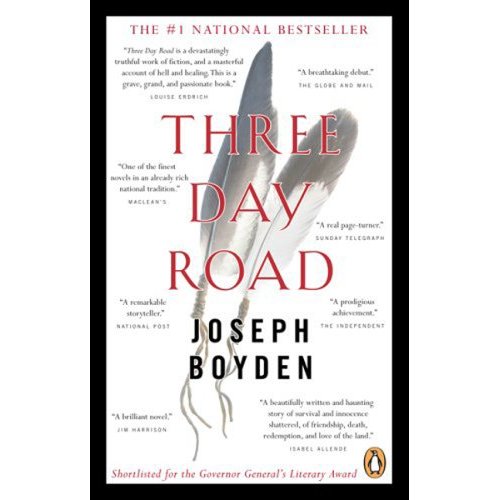
Three Day Road

It is 1919, and Niska, the last Oji-Cree medicine woman to live off the land, has received word that one of the two boys she grudgingly saw off to war has returned. She leaves her home in the bush of Northern Ontario to retrieve him, only to discover that the one she expected is actually the other.

Xavier Bird, her sole living relation, gravely wounded and addicted to the army’s morphine, hovers somewhere between the living world and that of the dead. As Niska paddles him the three days home, she realizes that all she can offer in her attempt to keep him alive is her words, the stories of her life.

In turn, Xavier relates the horrifying years of war in Europe: he and his best friend, Elijah Whiskeyjack, prowled the battlefields of France and Belgium as snipers of enormous skill. As their reputations grew, the two young men, with their hand-sewn moccasins and extraordinary marksmanship, became both the pride and fear of their regiment as they stalked the ripe killing fields of Ypres and the Somme.

But what happened to Elijah? As Niska paddles deeper into the wilderness, both she and Xavier confront the devastation that such great conflict leaves in its wake.

Inspired in part by real-life World War I Ojibwa hero Francis Pegahmagabow, Three Day Road  reinvents the tradition of such Great War epics as Birdsong and All Quiet on the Western Front. Beautifully written and told with unblinking focus, it is a remarkable tale, one of brutality, survival, and rebirth. Taken from Joseph Boyden web site.

More books by Joseph Boyden: Through Black Spruce, Born with a Tooth.

Quill and Quire Review