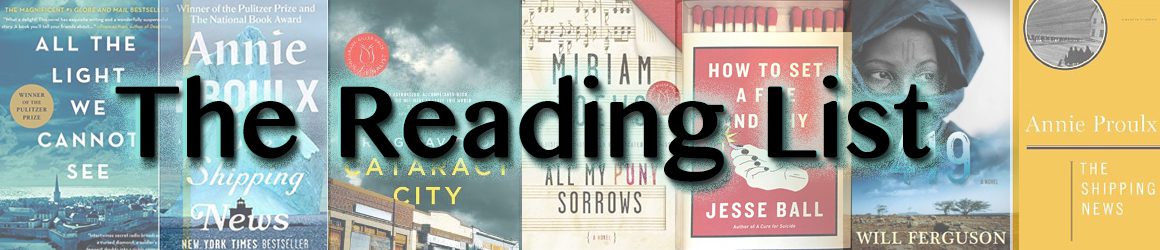
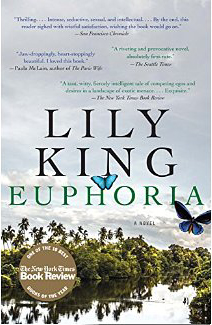
 Lily King explores the culture of the anthropologists of the 1930s as they raced to demystify the many unknown tribes in New Guinea. Inspired by the work of Margaret Mead, King explores the extraordinary work, personal sacrifice and risks taken by these anthropologists.
Planet Zoo by Anthony Doerr
(Read the original article here)
Here’s a metaphor: We’re in a car. The road is foggy and we’re cruising along at a good clip. A few signs on the shoulder warn there’s a cliff ahead, but the radio is on, we have places to be, and it’s not entirely clear who put up those signs anyway.
Some of us might slow down. A few might stop. One or two of us might put the kids in the backseat to work sewing parachutes.
But most of us keep going. Ultimately, we figure either:
- The cliff isn’t really there
- The cliff won’t be nearly as big as those signs make it look
- The cliff is so far away, our kids will be driving by the time we get there
- We’ll manage to skid to a stop right at the edge, or
- Shit, we’ll sail right off and hope our kids are virtuosos with parachute silk.
Reduce emissions, curb emissions, stop emissions. We—and by we I mean me, my friends, my older brothers, everyone I know under 45—we are the first generation that cannot claim we did not know. Silent Spring was published 10 years before I was born. At elementary school assemblies I was among the little curly-headed ciphers who read cheerful environmental tips into the microphone: “Don’t let the faucet run while brushing your teeth!” Freshman year in college we were handed Bill McKibben’s The End of Nature. During my sophomore year, 1992, 1,500 scientists, including more than half the living Nobel laureates, admonished in their Warning to Humanity: “A great change in our stewardship of the earth and the life on it is required if vast human misery is to be avoided and our global home on this planet is not to be irretrievably mutilated.”
So what have we done? Not much. From 1992 to 2007, global CO2 emissions from burning fossil fuels rose 38 percent. Emissions in 2008 rose a full 2 percent despite a global economic slump. Honeybees are dying by the billions1, amphibians by the millions, and shallow Caribbean reefs are mostly dead already.2 Our soil isdisappearing faster than ever before, half of all mammals are in decline, and a recent climate change model predicts that the Arctic could have ice-free summers by 2013. Unchecked, carbon emissions from China alone will probably match the current global level by 2030.
“The god thou servest,” Marlowe wrote in Dr. Faustus, almost 400 years before the invention of internet shopping, “is thine own appetite.” Was he wrong? How significantly have you reduced your own emissions since you first heard the phrase “climate change?” By a tenth? A quarter? A half? That’s better than I’m doing. The shirt I’m wearing was shipped here from Thailand. The Twinkie I just ate had 37 ingredients in it. I biked to work through 91-degree heat this morning but back at my house the air conditioner is grinding away, keeping all three bedrooms a pleasant 74 degrees.
My computer is on; my desk lamp is glowing. The vent on the wall is blowing a steady, soothing stream of cool air onto my shoes.
And now, in our lifetimes, we’re learning that perhaps this period is untenable, and like billions of species before us, we are not immune to extinction.
All the Light We Cannot See
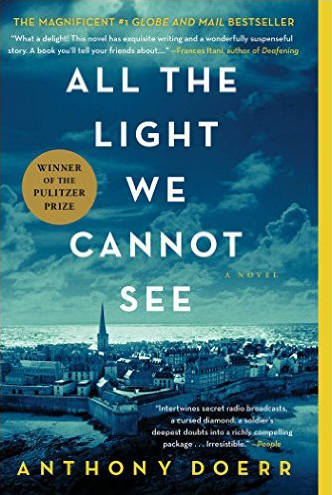 Winner of the 2015 Pulitzer Prize for Fiction, Anthony Doerr writes an enthralling story about love and empathy amidst the terrors of war and extremism. The story revolves around a blind young girl and her devoted father, who creates an exact replica of her town so that she can easily find her way.
The girl, Marie-Laure, had become blind by the age of six. Her father is a locksmith who works at the Museum of Natural History. As his daughter’s sight finally fails, her father builds her a model of Paris, and in this way she is able to navigate around the city. The Jardin des Plantes is their favourite place, and here Marie-Laure orients herself by counting drain covers and trees and streets, memorising routes and recognising the scents of trees and flowers.
In a parallel story, a young boy in Germany, Werner, an orphan, comes to the notice of the Nazis for his astonishing skill at fixing radios, and this leads to his relocation to an elite school aimed at providing skills for the Reich. Little Werner proves his worth and survives, even though the school is brutal and unrelenting.
When the Nazis arrive in Paris and begin to investigate the museum, demanding keys from Marie’s father, he makes plans to move to his uncle’s house in Saint-Malo. Despite her blindness, the girl is able to visualise the layout of the town when her father makes a small and detailed model of it. Months go by. Werner moves closer to the front as the Germans favour experts who can pick up radio transmissions from the allies. Life in Saint-Malo becomes increasingly difficult as the Germans take full control. Marie-Laure’s father is investigated and taken away, ending up in a German camp. Marie-Laure, virtually all alone with her eccentric great uncle now, joins the resistance and carries messages in baguettes. The Guardian
The Right to be Cold
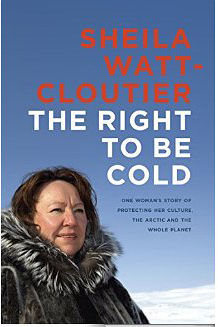 Sheila Watt-Cloutier shares her story in the Walrus. Naomi Klein reviews the book in the Globe & Mail. Klein writes,
Part of what makes this book so illuminating is that it insists on being more than a manifesto. In weaving politics with her own life story, themes emerge that challenge the tendency to treat climate change as some new and singular threat. In Watt-Cloutier’s narrative, just as dog sleds have been replaced by snow machines, so the emissions from the entire fossil-fuel-driven global economy are threatening the survival of her culture. And just as pollutants from industrial activities have ended up in the flesh and fat of the animals Inuit people rely on for food, so these same industrial activities are causing global temperatures to rise, threatening the continued existence of these same animals. Climate change, in other words, is nothing new – it is the ultimate expression of the same threats that have been ravaging this part of the world for a very long time.
Inuit culture, however, is far from dead and in fact is thriving despite the odds. That, argues Watt-Cloutier, is very good news, because her people’s hard-won knowledge about how to live sustainably on the land “could serve as a model for all nations, compelling the world to make the strong cuts in emissions needed to mitigate climate change.”
Uber vs The Taxi
 The Walrus talks about the fight between Toronto Uber and the taxi drivers in their latest issue HERE. According to the article, “The mayor wants to create a “level playing field,” where ride sharing can go bumper to bumper with licensed taxis. But for that to work, “Uber can’t continue operating like it’s the Wild West, where you can have anyone you like driving a car around without any regulation whatsoever. That’s not in the public interest.” Find out more about the people behind Uber HERE.
Uber is just one of the growing number of examples of how the modern generation is looking to help each other out. You can now book a couch (couch surfing) in someone’s living room in any country in the world, at a significant rate cut from a traditional hotel. Airbnb offers rooms in houses all around the world, stays for overnight or longer. You can find any article that you want searching in kijiji or craigslist. No store front, middle men or advertising dollars exchanged.
What should the politicians do, if anything, to curb this type of underground economy? Is it fair to the workers of the existing institutions? What do you think?
 Digitizeme